
A Virtual Exchange Project on Hybrid Phishing Email Detection: Integrating Machine Learning and Explainable AI
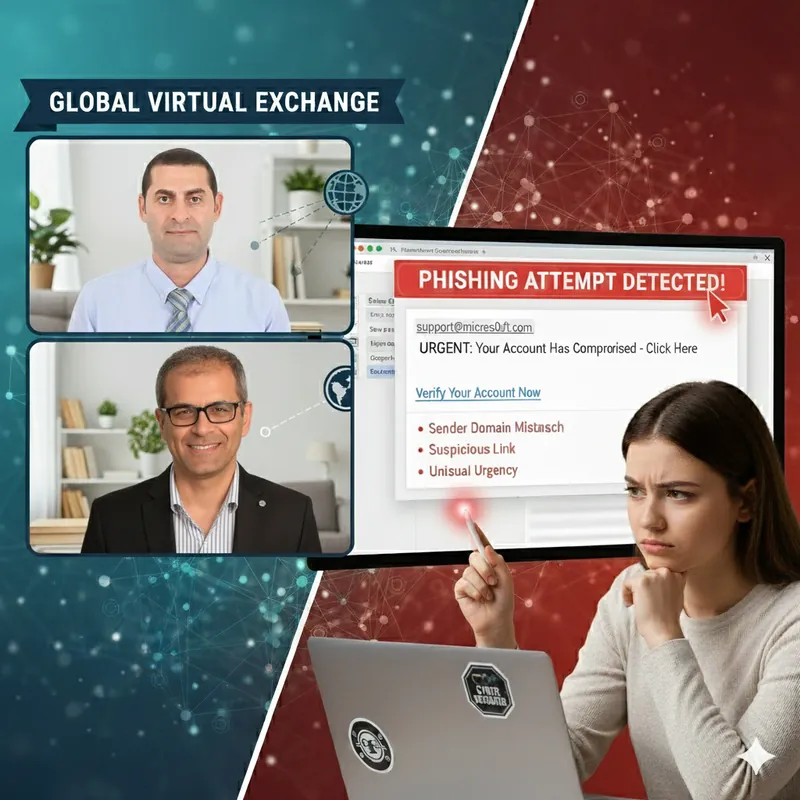
With the increasing use of emails in our daily lives, they have become a prime target of phishing attacks, posing a significant threat to users. Attackers pretend to be trusted sources and use phishing emails to trick people into clicking malicious links or opening harmful attachments. The aim of these attacks is to obtain sensitive information, such as financial data, login credentials, and personally identifiable information. Emails contain attributes such as the URL, sender, subject, receiver(s), and body. This paper presents a virtual exchange–based collaborative project that proposes a hybrid intelligence model integrating machine learning (ML) algorithms and natural language processing (NLP) techniques for phishing email detection. Three ML algorithms are employed: logistic regression, decision tree, and random forest. In addition, a customized ChatGPT model has been developed to receive classification results from the hybrid model. This model educates users on recognizing phishing emails by explaining classifications, highlighting suspicious keywords, and offering security tips. The virtual exchange framework enhances cross-institutional collaboration and global learning, while the proposed approach improves phishing detection, awareness, and user education.
Speakers
Ahmad Hasasneh
Alanna Tierno
Fadi Abuamara
Younus Y. Mirza
Contact us
- Younus Mirza
- ym••••a@su••••u.edu
Location
Classifications
Categories
- General
Age Groups
- All
Levels
- All