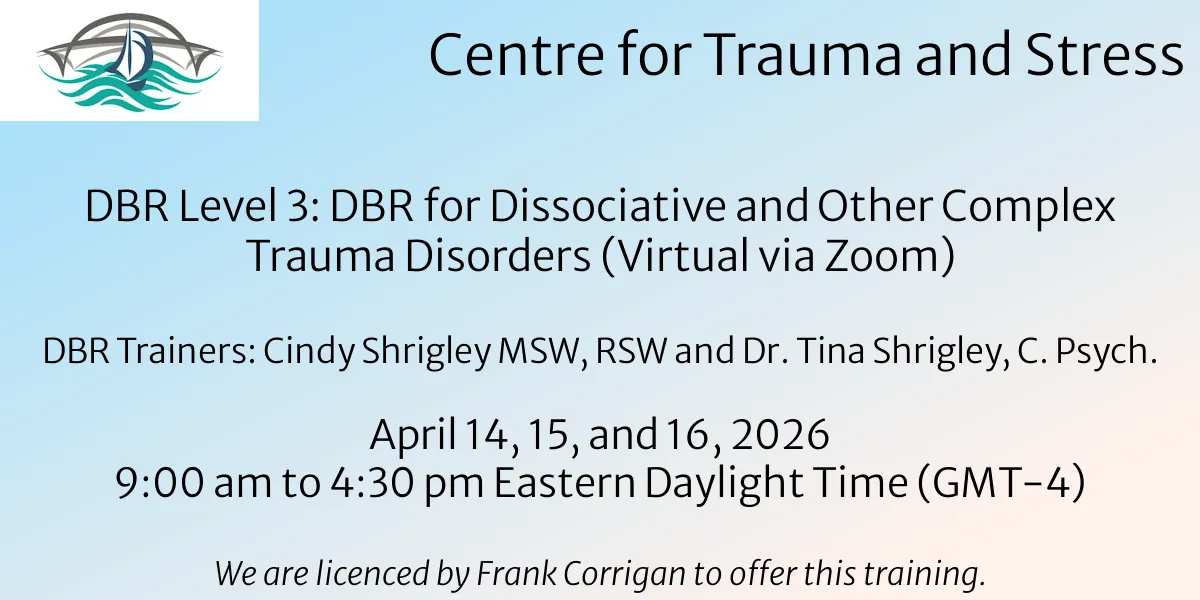
Reminder: there must be a gap of six months (minimum) between Level 2 and Level 3 training.
Also, you are expected to be using DBR with at least 20% of your clients.
Please note bookings which do not meet these criteria will be cancelled and subject to a 20% administrative fee.
DBR for Dissociative and other Complex Trauma Disorders
Level 3 DBR training forms the third part of DBR training and offers participants an opportunity to understand more about how the deeper layers of the self can be affected by trauma. In DBR the focus is not on the upper-level parts of the self, such as self-states, ego-states or alters – but on the underlying emotional pain and the rage, fear, grief, and shame that deep wounding generates.
Most therapists working with complex trauma disorders will have experience of working with trauma memory processing techniques and of attending to parts of the self that have become detached, to a greater or lesser extent, from everyday awareness.
As separated parts of the self probably involve circuitry through surface level loops – that can become detached from their traumatic origins in the brainstem affective and defensive loops – the focus in DBR is to work from the putative midbrain level. This means starting always from the Where Self when processing any of the traumatic experiences or working with young parts of self. This goes beyond basic grounding as it brings in a different perspective from the deeper level towards what is held in the surface-level circuitry.
Another difference with DBR is the focus on core attachment shock and pain and their associated affects. The hypothesis is that the clearing of the distress at its origin withdraws all distressing activation from episodic memories and stops them from having power to intrude through re-experiencing. DBR often starts with present-day activations as the aim is to provide treatment that is immediately relevant to the person’s quality of life.
Some therapy approaches work primarily with traumatised parts of the self, getting to know them and increasing their communication and co-operation, as well as orienting them to the present. These methods are effective but don’t always get to the underlying pain of aloneness and abandonment. In DBR the focus is, instead, not on the upper-level parts of the self – but on the underlying emotional pain and the rage, fear, grief, and shame that this deep wounding generates.
Working at this lower level of the brain is difficult because the brain has found it necessary in the past to turn away from the pain. However, the person is now in a different situation, at a different age, and may have the capacity to confront that pain in a way which allows healing at the core of the trauma and abuse history. The brain has gone on developing around that core pain in such a way that it might now be helpful to approach it from a different angle.
There are no clinical studies of DBR for core aloneness pain in complex trauma and dissociative disorders – and none that compare it with approaches that focus on the parts of the self that have become compartmentalised. Sometimes people move between the approaches – working with the parts when necessary, working with the pain when possible. This training is, however, focused on the core emotional pain and its associated affective and defensive responses rather than the separated parts of the self.
Key Learning Outcomes
After the training participants will be able to:
• Understand the role of core aloneness pain in the long-term effects of early-life trauma.
• Know how to elicit the sequences from shock and pain to affects and defences – even when these lead into dissociated parts of self.
• Understand the use of the Protoself access in preparation for deep-level processing.
• Know how to get beneath the overt symptoms in other disorders, such as obsessive-compulsive disorders, to process the underlying conflicts.
• Understand the role of the Orienting Tension as an opener of a specific file into an unconscious conflict.
What those attending will learn that will improve their DBR practice or clinical outcomes.
• How to apply DBR in complex trauma disorders in which processing of trauma memories is difficult because of emotional dysregulation and/or dissociation.
• How to differentiate different dissociative responses according to their putative pathophysiological or neuroscientific mechanisms.
• How to use the Where Self / Protoself approaches to access unconscious conflicts.
• How to assist the endogenous healing process when there is core aloneness pain from very early in life.
Who should attend?
DBR Level 3 training is for mental health professionals who have completed DBR Level 1 and Level 2 training. Due to the theoretical complexity and clinical experience needed, a six month gap (minimum) is required between DBR Level 2 and DBR Level 3 training, along with regular use of DBR in practice with at least 20% of clients.
Please Read Before Registering:
DBR Training Attendance and Exclusion Criteria
Frank Corrigan has established the following policies and criteria to ensure consistency and fidelity in the training and implementation of DBR. DBR Training attendance and exclusion criteria
Specifically for Level 3:
DBR Level 3 training is for mental health professionals who have completed DBR Level 1 and Level 2 training. Due to the theoretical complexity and clinical experience needed, a six month gap (minimum) is required between DBR Level 2 and DBR Level 3 training, along with regular use of DBR in practice with at least 20% of clients.
• a core professional qualification in mental health and/or psychotherapy
• a minimum of 2 years clinical psychotherapy experience post accreditation/ registration/ clinical licensure
• current professional body/state board accreditation/ registration/ licensure
• current professional indemnity insurance
• significant experience of working with trauma and/or trained in psychologically based trauma focused approaches
Please note bookings that do not meet the attendance criteria will be cancelled and subject to a 20% cancellation fee.
For guidance, please refer to the list of accepted professions/ qualifications and professional/ regulatory bodies below. The list is not exhaustive. Please also read the exclusion criteria carefully.
Exclusion Criteria
DBR training is not suitable for
- Therapist in training
- Practitioners without a core professional mental health qualification and who are trained in another therapeutic modality e.g. Biofeedback, Internal Family Systems, Neurofeedback and Somatic Experiencing
- Hypnotherapists, Massage Therapists, Yoga Therapists, Therapeutic Coaches without core professional mental health qualification.
If you are making an inquiry regarding your eligibility for training in DBR, please note that we provide trainings internationally. Please provide clear and detailed information including:
• registering/professional affiliations in full – i.e no acronyms
• duration of core training
• full details of the training body
• duration and specifics of modules pertaining to psychotherapy/mental health
• the exact academic level e.g. Post Graduate Diploma (of 2 years duration)/Masters (3 years with 2 years clinical practice experience)
Cancellation Policy
• You will be refunded if you cancel 1 month or more before the date of the training. A 20% cancellation fee will be applied.
• You will not be refunded if you cancel within 1 month of the date of the training.
• There is no refund if no notice of cancellation is received before the date of the training.
• Registrations that do not meet the attendance criteria will be cancelled and subject to a 20% cancellation fee.
• There is no refund for partial hours if you are only able to attend a portion of the training.
• Where a training is cancelled due to trainer illness or other unforeseen circumstances, you will receive a full refund.
Participation and Confidentiality Agreement
• I acknowledge and agree that the Trainings are the exclusive intellectual property of Deep Brain Reorienting® and ©Dr Frank Corrigan, who is the exclusive owner or licensee of all materials utilised in the Trainings including, but not limited to, all printed, audio, video, digital, online, and other materials (“Materials”). The Materials also include all duplicates, reproductions, and derivatives of the Materials, as well as any materials, research, books, articles, and other works of authorship, as well as products or services, created by Dr Frank Corrigan and related to the Trainings (collectively, “Materials”).
• I shall not make any audio, video, audiovisual, or other recordings of any portion of the Trainings nor shall I duplicate, reproduce, distribute, publish, or discuss any of the “Materials” and confidential information contained in or related to the Trainings.
• I agree that all personal information of any participant relayed within the Trainings is strictly and completely confidential. I shall not disclose any of this confidential information to any other person or entity under any circumstances.
• If I agree to participate in the Trainings as the subject of a demonstration, I am doing so voluntarily and at my own risk. I further understand that I am under no obligation to participate in the demonstration, that I may refuse to answer any question, and that I may pause or discontinue my participation in the demonstration at any time at my discretion.
• Recording and filming waiver. I understand that if DBR Training and Certification Company Ltd approves the recording of a Training, my image and voice may be in the video or recording. By participating, I waive any right to approve the video or recording, and waive my right to any payment for participation.
• I understand that the primary reason for participating in and receiving the training is educational. The programme includes experiential practicum components where participants are asked to be the recipient of a DBR practice session. As these are training sessions rather than part of any ongoing treatment, each participant is responsible for choosing to work on something that is appropriate to their own therapeutic work, and which will facilitate learning in a DBR way. It is equally important for all participants to remain mindful of the material they choose to explore in practicum work and to arrange any follow-up as felt necessary.
• I understand that participation in trauma processing therapies can be inherently unpredictable, and therefore agree to participate at my own risk. Even where an issue is selected that may not appear to be particularly ‘significant’, I understand that this may lead to material arising that is unresolved within my nervous system, this may require ongoing personal therapy work, post the training event. I understand that this is my personal responsibility to attend to and agree to arrange follow-up therapeutic support as needed, and I cannot hold the organisation, trainer, training team nor other participants responsible for this.
• If I wish to present Deep Brain Reorienting in a public format, I hereby agree and acknowledge that I must seek and be granted prior approval in writing from Dr. Frank Corrigan. (For enquiries please contact: jo@deepbrainreorienting.com) • I accept responsibility for any risks involved in implementing content learned here. I agree to indemnify and hold faultless Deepbrainreorienting Limited and its partners for any negative outcomes from such implementation.
• In the event that Deepbrainreorienting Limited or its authorised representatives or the Trainings organiser requests that I discontinue my participation and involvement with a live Training, I will immediately leave the Training. If I withdraw from the Training, the Centre for Trauma and Stress refund policy applies.
• I understand that if I suffer from any health risk or am pregnant and I elect to proceed with the Trainings I do so at my own risk. If I am pregnant I may wish to consider participating in a future training date.
• Responsibility for technology. For online training, it is my responsibility to participate with a computer and internet access that will allow my consistent participation and attention in an environment that also ensures confidentiality of materials shared in the training, including during the practicum. If I am not able to participate consistently, or if I am joining the training from a location that is distracting or unsafe (i.e. while driving), especially during practicums, I may be asked to leave until I am able to be in an environment that best facilitates learning for you and others.
• I understand that personal data, such as name, email address, personal account preferences, transactional data, such as purchase information, and technical data, such as information about cookies, are collected so that I can be sent further information about DBR and Trainings.