Upcoming
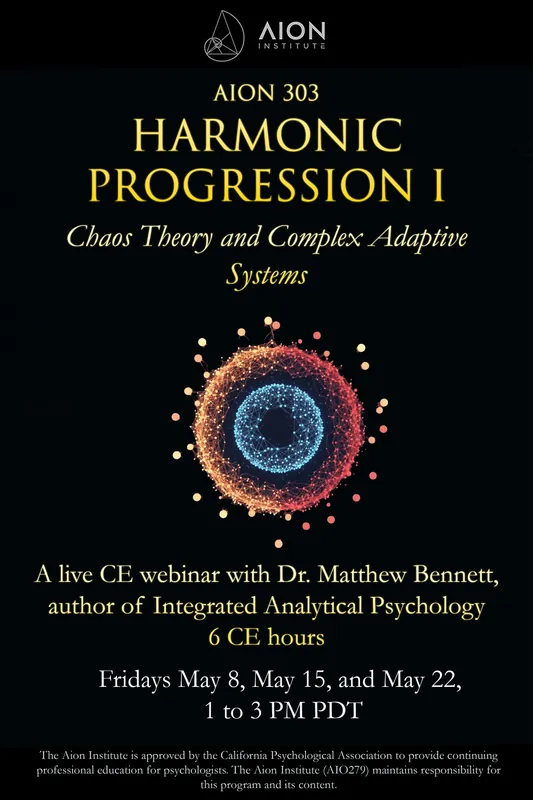
AION 303 Harmonic Progression I: Chaos Theory and Complex Adaptive Systems
From $ 320 usd
Fri, May 8, 2026, 1:00 PM PDT – Fri, May 22, 2026, 3:00 PM PDT
Online Event
Dates Breakdown
Fri, May 8, 2026, 1:00 – 3:00 PM PDT
Session 1 of 3
Fri, May 15, 2026, 1:00 – 3:00 PM PDT
Session 2 of 3
Fri, May 22, 2026, 1:00 – 3:00 PM PDT
Session 3 of 3
Course Description
Drawing from Matthew Bennett’s Integrative Analytical model, this course will explore how principles of complexity and chaos theory offer a powerful alternative framework for understanding mental representation and consciousness, moving beyond traditional psychoanalytic and cognitive-behavioral paradigms while incorporating Jungian and post-Jungian sensibilities. Beginning with the notion that mental complexity arises from a breakdown of primordial symmetry, this conversation traces how the human mind responds to these disruptions by creating increasingly complex internal models to assess and shape reality. This perspective draws heavily from the concept of deterministic chaos, where systems governed by clear initial conditions can produce wildly unpredictable outcomes through nonlinear interactions between attractors (forces that promote coherence) and dissipators (forces that introduce change and breakdown), the concept of Complex Adaptive Systems (CAS), the philosophical position of Emergentism, and the Bayesian Brain Hypothesis, which frames the brain as a prediction and hypothesis-testing machine, constantly updating its internal models to minimize uncertainty and “free energy.”
Learning Objectives
- Describe core principles of chaos theory and complex adaptive systems—including nonlinearity, emergence, attractors, and phase transitions—and explain how these principles offer an alternative framework for understanding mental representation and consciousness.
- Analyze psychological development and psychopathology as emergent responses to symmetry-breaking events (e.g., trauma, loss, developmental disruption), enabling clinicians to conceptualize symptoms as adaptive attempts at coherence rather than isolated deficits or dysfunctions.
- Differentiate traditional linear models of mind (e.g., classical psychoanalytic and cognitive-behavioral formulations) from nonlinear, emergentist perspectives, and evaluate the clinical implications of each for formulation, prognosis, and therapeutic change.
- Apply concepts from deterministic chaos, the Bayesian Brain hypothesis, and free-energy minimization to clinical material in order to formulate treatment as an iterative process of revising internal models, tolerating uncertainty, and supporting adaptive reorganization of meaning and self-experience.
The Aion Institute is approved by the California Psychological Association to provide continuing professional education for psychologists. The Aion Institute (AIO279) maintains responsibility for this program and its content.
Instructors
Matthew Bennett
Clinical Director
Contact us
- Aion Institute
- in••••o@aio••••e.com
Location
Online Event
Classifications
Categories
- CE Event
- Certificate in Integrated Analytical Psychology
Levels
- Advanced (For those prepared to engage with nuance, synthesis, and transformation.)