Started
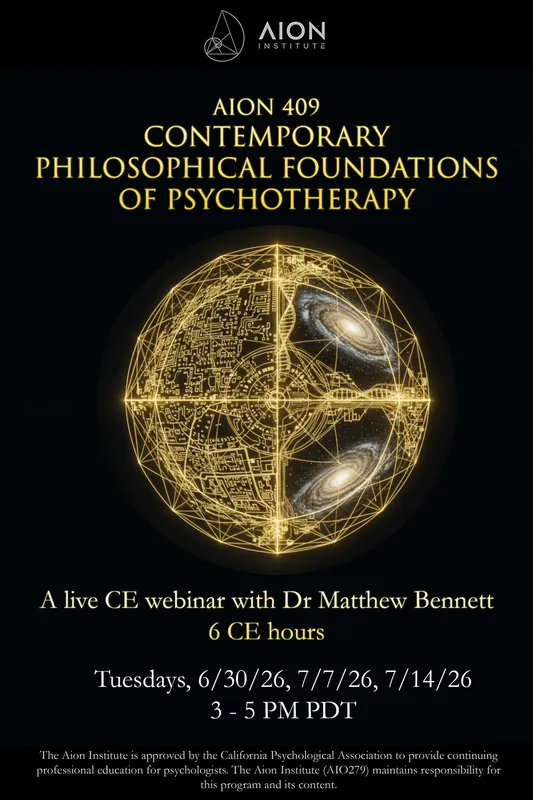
AION 409 Contemporary Philosophical Foundations of Psychotherapy
From $ 320 usd
Tue, Jun 30, 2026, 3:00 PM PDT – Tue, Jul 14, 2026, 5:00 PM PDT
Online Event
Dates Breakdown
Tue, Jun 30, 2026, 3:00 – 5:00 PM PDT
Session 1 of 3
Tue, Jul 7, 2026, 3:00 – 5:00 PM PDT
Session 2 of 3
Tue, Jul 14, 2026, 3:00 – 5:00 PM PDT
Session 3 of 3
Course Description
From Kant’s “veil of appearances” to Deleuze’s “infinite becoming,” this course traces the philosophical roots and modern continuations of constructivist and psychodynamic thought, exploring how foundational ideas shape contemporary clinical theory. We will examine Constructivism and German Idealism, with particular focus on Kant’s critical philosophy and its deep influence on Jung’s psychological framework—especially Jung’s notions of archetype, the limits of knowledge, and the structuring role of the psyche. The seminar will also engage with contemporary Continental perspectives, particularly the provocative insights of Slavoj Žižek and Gilles Deleuze, whose work challenges linear, structuralist thinking and reimagines desire, subjectivity, and reality in dynamic, nondual terms. Participants will gain a conceptual bridge between classical philosophical roots and postmodern frameworks, considering how these paradigms inform depth psychological practice and the ethics of therapeutic engagement.
Learning Objectives
- Describe core principles of constructivist and post-Kantian philosophy—including the limits of knowledge, mediation of experience, and the structuring role of the subject—and explain their relevance to depth psychological theory and clinical formulation.
- Analyze the influence of Kant’s critical philosophy on Jung’s psychological framework, particularly in relation to archetypes, symbolic mediation, and the ethical implications of epistemic humility in clinical work.
- Differentiate structural and constructivist models of psyche from contemporary Continental approaches emphasizing becoming, multiplicity, and desire, thereby expanding clinicians’ conceptual repertoire for understanding subjectivity and change.
- Apply philosophical insights from contemporary thinkers to psychotherapeutic practice, especially regarding interpretation, ethical restraint, and the clinician’s responsibility when working with ambiguity, difference, and non-linear transformation.
The Aion Institute is approved by the California Psychological Association to provide continuing professional education for psychologists. The Aion Institute (AIO279) maintains responsibility for this program and its content.
Instructors
Matthew Bennett
Clinical Director
Contact us
- Aion Institute
- in••••o@aio••••e.com
Location
Online Event
Classifications
Categories
- Elective (applicable to all certificate programs)
- CE Event
Levels
- Introductory (For those beginning the path or seeking reorientation)