
Boulder to Sport Climbing
What is Sport Climbing?
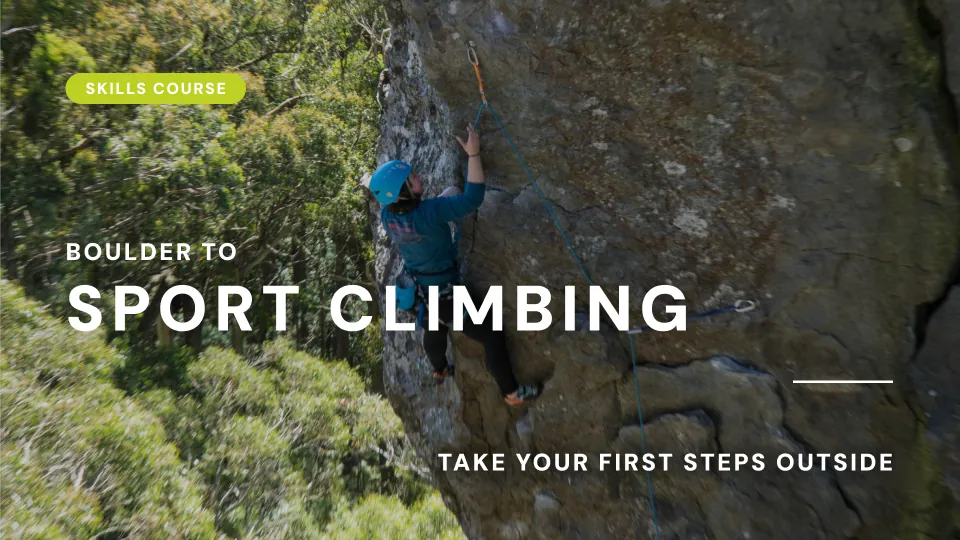
Sport climbing means that there are permanent bolts/hardware in the rock, which has the advantage that a minimum of gear is required to safely climb on them (you don’t need to buy as much gear to start climbing in the outdoors, yay!). Since the fixed hardware is specially designed for this purpose, the techniques to learn are much simpler than traditional – “trad” – climbing, and can be comprehensively covered in two days for those with no prior ropes experience.
What will we learn?
On this course you will learn:
Belayer Skills:
- Threading the belay device
- Partner checks
- Communication
- Hand position on the ropes
- ‘Spotting’ the climber
- Quickly taking, and giving rope
- Short-roping
- Watching for climber mistakes, providing feedback
- Catching leader falls (small to large)
- Feet position on the ground, on the wall
- Different types and styles of belay devices and how to use each.
Climber skills:
- Knot tying
- Communication
- Partner Checks
- Clipping the rope (and common mistakes)
- …More clipping (it is harder than it looks)
- Taking a leader-fall (we start small, don’t worry!)
Sport-Climbing Specific skills:
- Apply indoor lead-belay and lead-climbing techniques to outdoor rock
- Return at the end of your session without leaving any of your equipment behind
- Inspect fixed sport climbing hardware and anchors before you use them
- Recognise the most common sport climbing mistakes and easy methods to mitigate them
- Make intelligent decisions in the outdoors.
BONUS – as part of this course you will learn about the humble prusik loop – a very simple, extremely useful piece of climbing equipment that not many sport climbers carry or even own. You will learn just how useful it can be in all sorts of situations, and as a special thank-you for signing up to this course – we’ll give you one to keep!
Where is it held?
This session is held on an outdoor location on real sport climbing routes. The area we climb at and the grade of the routes will be tailored to the group participant’s skill levels.
Is it an all-day course?
The session will take approximately 6 hours of learning time per day.
Prerequisites
Unlike the 1-day Sport Climbing Conversion course, this course is suitable for those with no prior ropes experience. Given the location we are planning to use however, it is helpful if you are confidently bouldering at around V2 or higher, and have some head for heights.
Aims of this course
The goal of the session is to first introduce environmental concerns when climbing in the outdoors and how to mitigate these. Every participant will then climb at least four outdoor sport climbs, each practicing a different skill set (practiced at ground level before leading up). The climbs, in order, are:
- basic sport climbing with pre-clipped bolts (we'll do this several times on the first day to comprehensively cover all of the belay techniques!)
- thread-and-lower - passing the rope through the fixed hardware and being lowered to the ground
- thread-and-abseil - starting the same as the first exercise, but the goal is to abseil down using an ATC+prusik combo instead.
- safely bailing from a sport route, without leaving a leaver-biner behind – and when it is appropriate to do this.
Finally, if time allows, participants will learn some additional skills, including belaying from the top of a route (and safely lowering a partner), how to how to prusik up a rope, e.g. to regain a roof after falling off, and how to clip a bolt that is out of reach.
What do we need to own/bring?
The only piece of equipment you need to own before this course is a standard climbing harness suitable for lead-climbing indoors. All other climbing safety equipment is provided by The Climbing Company, however if you own any of the following equipment please bring it along with you – learning with your own equipment is far better and will provide a great start to your outdoor climbing experience!
- Helmet *
- One locking biner suitable for belaying
- One belay device
- If you own a chalk bag, rope, quickdraws, slings and any other sport-climbing equipment please let us know prior to the course, and we can plan to teach you using your own gear instead.
* Helmets are worn on all outdoor Climbing Company courses – but as with all of the other climbing safety equipment, we have these if you don’t own one, and we will not charge any extra for their use on the course.
Loose Climbing Shoes are most useful and safest for learning on. Wearing your uber-tight gym shoes is possible but will be painful after a full day so it certainly isn't recommended!
Non-climbing gear: You will need to bring suitable clothing and footwear for light hiking, and your own lunch and water for the day (and a camera!).
Contact us
- Aaron Lowndes
- aa••••n@the••••y.com.au
- 0424 383 831
Location
Classifications
Categories
- LTL
- I2O
Levels
- Beginner