ཁ་སྐད་ཆོས་ཚིག་ཟུང་འབྲེལ། Unity of Colloquial Language and Dharma Terminology
EDP (English for Dharma Purpose) and Colloquial Language Student Pilot Short Course
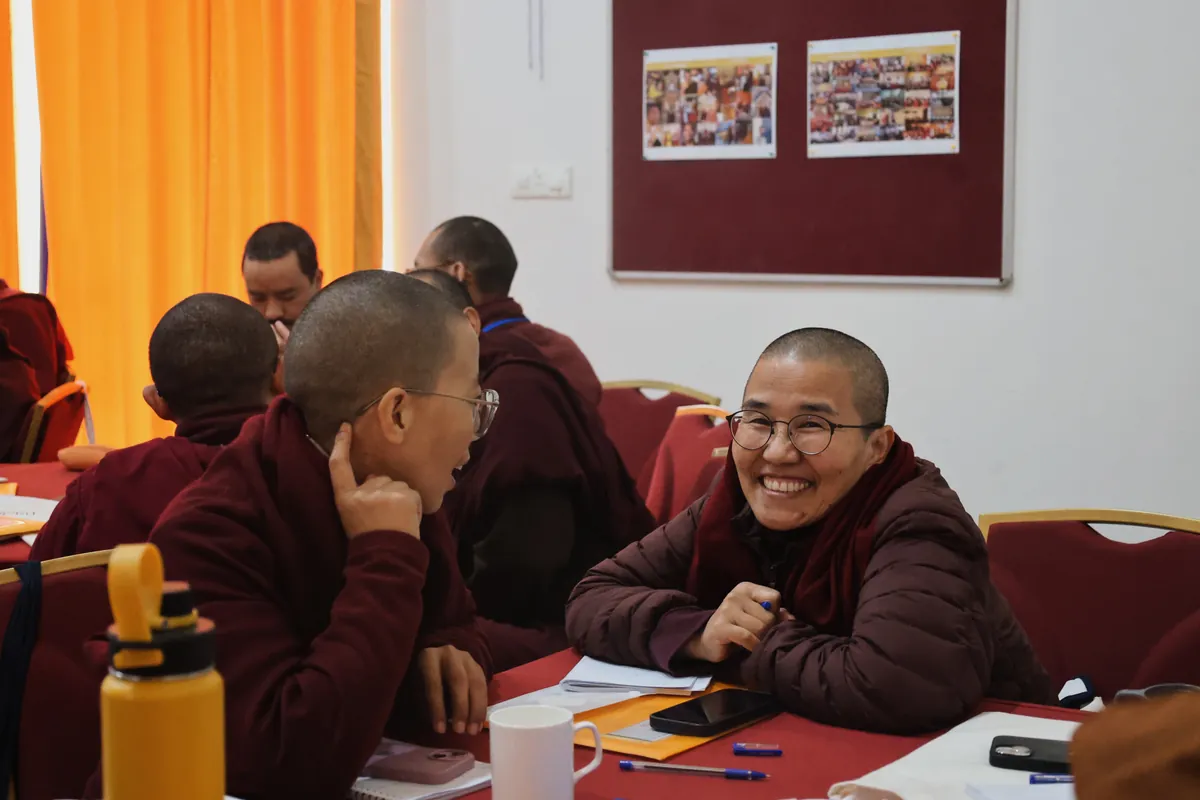
This 8-week pilot Short Course is designed around basic Dharma topics, such as life of a monastic, the temples and monasteries, world religions, etc. Rather than these topics being studied from a book or other written resources, the students will mainly explore them by having direct live interactions with the nuns from the EDP (English for Dharma Purpose) program. They need to actively engage with them in order to obtain the information and insights they are hoping for and for their relevant questions to be answered. Given the cultural diversity and possible gaps between the Tibetan language learners and the nuns, inter-personal and cultural skills will also be relied upon and enhanced. These interactions will take place in Tibetan, English and སྐད་ར་མ་ལུག, aiming at a balance and therefore equal benefit for the Tibetan language students and nuns, who are beginner and intermediate English language learners.
In addition to the interaction with the monastics, there is an important component of building and growing one’s own metacognitive awareness. The reflections about this take place both in the SLC and in guided debrief sessions after the exchange with the monastics.
OBJECTIVES
The North star objective is:
Advanced Tibetan students will aim for higher metacognitive awareness, enabling them to identify the factors that support or hinder their participation in Dharma events—such as listening to talks, asking questions, and sharing personal insights.
The three main objectives of this Short Course in particular are:
- Train themselves to actively listen to Dharma talks or Dharma-related conversations in Tibetan using self-interpretation strategies.
- Relying on relevant vocabulary and grammar skills, formulate and ask Dharma-related questions in Tibetan with appropriate context and nuance.
- Identify key conditions, personal encounters, methods, and plans to guide their ongoing reflection and learning journey.
In order for this collaboration to be equally fruitful, both parties are aware of the objectives of the other learning group and try their best to support their learning process.
METHODOLOGY
During eight weekly live sessions Advanced colloquial Tibetan students will have the opportunity to discuss with nuns in each Zoom breakout room about Dharma related topics in both Tibetan and English language.
The main language skills to be focused on are listening, speaking and interpreting. (Interpreting is being used as a tool to ensure comprehension rather than aiming at eloquence and subtle interpreting details.) All of the topics are Dharma related and therefore of direct benefit to the students’ goal of understanding Dharma teachings in Tibetan. The method will be that both groups of students train their speaking and listening skills in the target language. According to the level of skills of the students, there will be a variety of learning opportunities where they practice speaking and listening in their target language and/or another person doing the sequential interpretation as a form of language practice and listening comprehension evaluation.
As a preparation for these live sessions, colloquial students familiarize themselves with the respective topics during their weekly 1:1 tutor sessions with our regular language tutors and SLC meetings as well as through their self-study. They are also expected and encouraged to think of relevant and nuanced, culturally appropriate questions in Tibetan. These questions will be collected on a shared Google Doc. (linked to the དཀར་པང་།) beforehand so that the nuns can also think about their replies. The nuns might also have questions for the Tibetan language students.
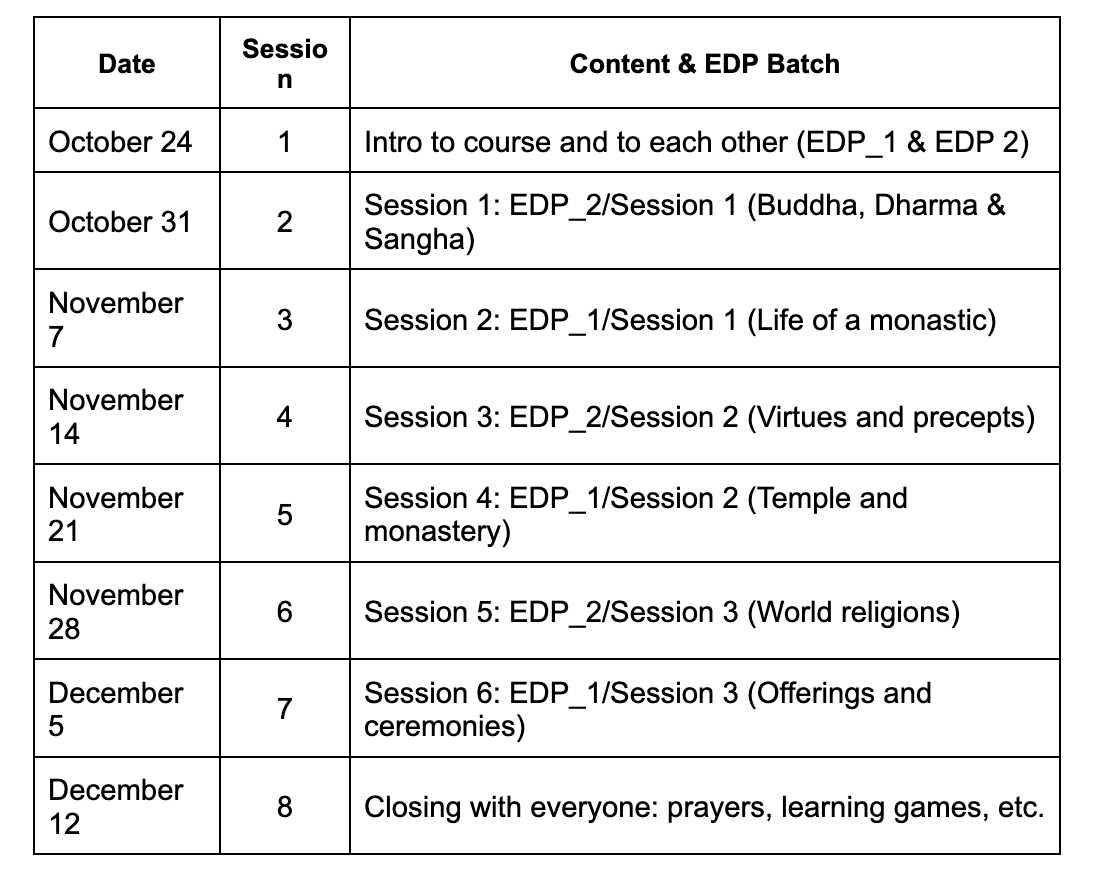
The nuns will belong to two different EDP batches; EDP_1 are beginners, EDP_2 are intermediate English learners. The live classes will alternate between these two groups, three sessions with each batch, first and last one with both of them.
Before, while and after these live interactions with the nuns, the students are encouraged to closely observe their own learning and the gaps which hinder communication in order to explore ways to close those. In other words, these sessions serve the colloquial students to identify key elements and methods of their learning and discuss ways to enhance them with peers who share the same experiences.
LIVE SESSIONS
The live classes are structured in the following way:
10 min. Introduction to the topic and tasks
45 min. Discussion in the breakout rooms (one-two EDP nuns with some colloquial students)
15 min. 1-minute synopsis of some EDP and colloquial students in their respective target language
5 min. Conclusion together
Short break
30 min. Reflection about the experiences, insights, challenges encountered during the preparation and discussion in the breakout room phase
Day: Saturdays
Time: 8 PM IST (4:30 PM CEST on October 24, 3:30 PM CEST on all other Saturdays)
Duration: 1.5 hours + short break
SCHEDULE, TOPICS & EDP BATCH
MATERIALS
Students will be provided with a weekly tutor sheet which has inputs to discuss the relevant topic with the tutors as well as on Saturdays with the nuns. The དཀར་པང་།, lesson plan, will also be available on the Moodle platform beforehand. Recordings of the live sessions are offered via Google DRIVE or YouTube (depending on the number of colloquial students due to the sharing limits of YouTube).
FEEDBACK AND EVALUATION
According to a structured system, the students provide a short and constructive feedback to the nuns about their language skills and 1-minute synopsis. Those who don’t have a chance to do their “1-minute speech” during the live session will send a recording into the shared WA group. The feedback will of course be provided individually and privately.
A rubric serves the colloquial students to auto-evaluate their learning and progress both with respect to their language as well as soft skills.
FACILITATORS
Various facilitators, both native and non-native speakers from both programs will guide through these sessions.
PRICE
The price for this short course is $108 for the auspicious beginning of this small, initial collaboration which will hopefully grow into something larger in the future. This includes the eighth weekly tutor sessions. A monastic discount of 30% is available too.
PILOT PROJECT
Given not only this is a pilot project at SINI, but we are not aware of any other programs who offer such joined sessions with monastics, this is a complete trial and pilot project. We do not have any reference points, experience or place to receive guidance and advice from. It will therefore be a steep learning curve for everyone involved and we appreciate your patience, flexibility and openness about this. We also welcome constructive feedback in order for this collaboration to grow and hopefully become an integral part of both the EDP and colloquial programs at SINI.
བཀྲ་ཤིས་ཤོག
Instructors
Gen Franziska Oertle
Contact us
- Tzoe Wong
- ti••••i@gma••••l.com
Location
Classifications
Categories
- Tibetan Language Online Courses
Age Groups
- All
Levels
- All