
SPL3101: Prophetic Healing and Deliverance Practicum
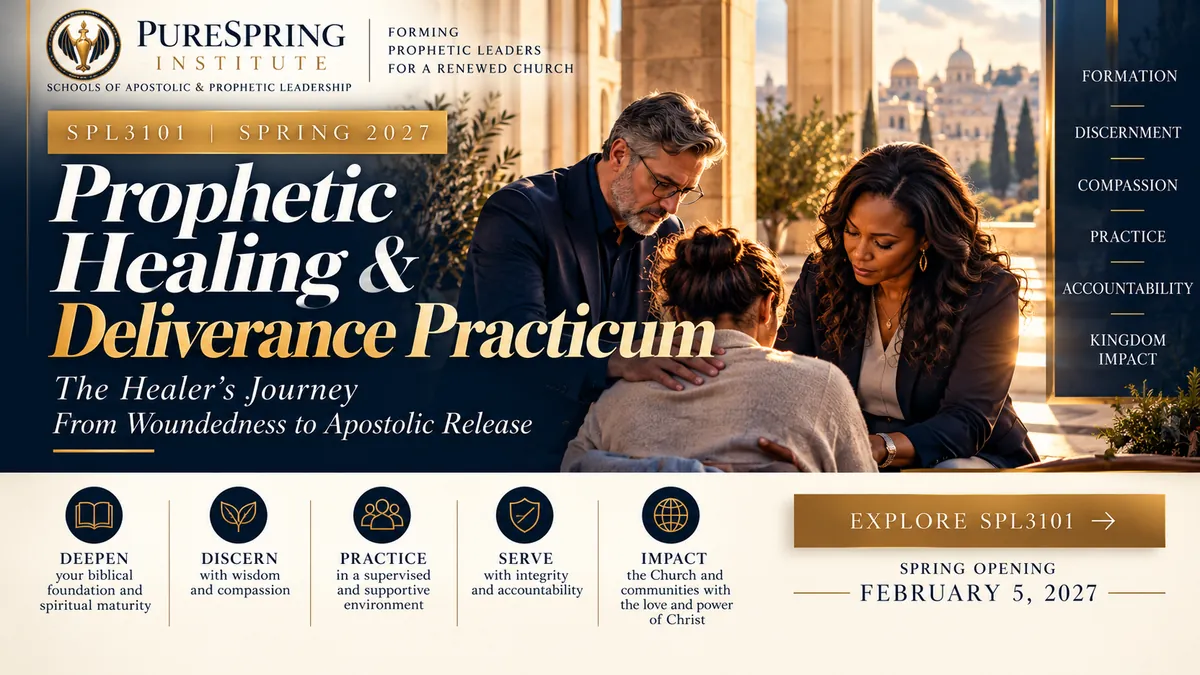
SPL3101: Prophetic Healing & Deliverance Practicum
The Healer’s Journey — From Woundedness to Apostolic Release
PureSpring Institute | School of Prophetic Leadership | Spring 2027 Formation Cohort
Guiding Question: How Do I Partner with Christ in Healing, Deliverance, and Restoration?
Course at a Glance
| Course Detail | Spring 2027 |
| Course Code | SPL3101 |
| Course Title | Prophetic Healing & Deliverance Practicum |
| Course Type | Supervised Ministry Formation Practicum |
| Opening Date | Friday, February 5, 2027 |
| Final Instructional Date | Friday, May 14, 2027 |
| Duration | 14 instructional weeks |
| Contact Hours | 60 planned instructional contact hours |
| Format | Weekly instruction, four Saturday intensives, guided practice, and supervised application |
| Delivery | Live hybrid formation experience |
| Institution | PureSpring Institute — School of Prophetic Leadership |
FORMED™ • EQUIPPED™ • SUPERVISED™ • SENT™
BEYOND LEARNING ABOUT HEALING: BECOMING PREPARED TO MINISTER
Jesus did not simply teach about the Kingdom of God. He demonstrated it.
Throughout the Gospels, His proclamation of the Kingdom was accompanied by compassion, healing, deliverance, restoration, and the transformation of human lives.
He then equipped His disciples to participate in that ministry—not as performers of spiritual power, but as servants entrusted with the message and ministry of the Kingdom.
SPL3101: Prophetic Healing & Deliverance Practicum is an extended, supervised ministry formation experience designed to prepare developing healing ministers to serve with biblical understanding, spiritual maturity, compassionate discernment, ethical responsibility, and appropriate accountability.
Over 14 instructional weeks, participants move beyond exposure to healing ministry concepts into a structured process of theological study, personal formation, guided practice, supervised application, case reflection, and competency development.
This practicum recognizes that healing ministry involves more than spiritual sensitivity or confidence in prayer. It requires the capacity to listen carefully, interpret responsibly, protect human dignity, exercise appropriate boundaries, collaborate with others, and recognize when additional pastoral or professional support is needed.
At the heart of SPL3101 is a foundational conviction:
Those who minister healing must themselves be continually formed by the Healer.
The objective is not simply to produce individuals who know more about healing and deliverance.
It is to cultivate ministers who increasingly reflect the character of Jesus Christ while participating responsibly in His restoring work.
THE GUIDING QUESTION
How Do I Partner with Christ in Healing, Deliverance, and Restoration?
SPL3101 belongs to the Practice dimension of the School of Prophetic Leadership curriculum.
Its central concern is not merely whether a participant understands healing prayer or has previously participated in deliverance ministry.
The deeper question is:
How do I minister to people in a way that faithfully represents Jesus Christ?
Throughout the practicum, students learn to hold together essential dimensions of responsible ministry:
- Compassion and spiritual authority
- Discernment and humility
- Faith and wisdom
- Prayer and appropriate practical care
- Prophetic sensitivity and pastoral responsibility
- Spiritual formation and demonstrated competency
- Ministry participation and accountable oversight
The resulting approach centers on Christ, the dignity of the person receiving ministry, and the long-term well-being of those being served.
THE HEALER’S JOURNEY
From Woundedness to Apostolic Release
The organizing theme of SPL3101 recognizes that healing ministers are not formed through information alone.
They are shaped through an ongoing journey of surrender, biblical understanding, personal restoration, responsible practice, spiritual maturity, and faithful stewardship.
Participants explore five interconnected dimensions of that journey.
CALLED — Recognizing the Invitation
Discerning God’s invitation to participate in His ministry of healing, restoration, and reconciliation without presuming that every desire or spiritual impression constitutes an immediate ministry assignment.
FORMED — Becoming a Trustworthy Vessel
Examining personal identity, character, motivations, spiritual disciplines, relational patterns, unresolved wounds, and the responsibilities associated with serving vulnerable people.
EQUIPPED — Developing Understanding and Skill
Strengthening biblical foundations, ministry judgment, discernment, listening, prayer practices, ethical safeguards, and the ability to respond appropriately to different ministry situations.
SUPERVISED — Learning Through Accountable Practice
Applying learning through structured exercises, ministry simulations, supervised encounters, observation, feedback, documentation, and reflection.
SENT — Preparing for Faithful Service
Integrating formation and competency into an accountable approach to ministry within the Church, approved ministry environments, and future opportunities for service.
Release is not independence from accountability. It is increasing readiness to serve faithfully within appropriate spiritual, relational, and organizational oversight.
THE SPRING 2027 FORMATION EXPERIENCE
14 Instructional Weeks • Four Saturday Intensives • 60 Planned Contact Hours
The Spring 2027 practicum uses an extended instructional model that allows participants to develop understanding and practical competency over time.
Rather than concentrating formation into three weekends, the revised schedule provides opportunities for preparation, instruction, application, feedback, reflection, and progressive development throughout the semester.
Weekly Instruction
Fridays | 7:00–9:00 PM Eastern
The weekly instructional rhythm includes biblical and theological study, guided discussion, case analysis, ministry protocols, demonstrations, reflective assignments, and preparation for supervised application.
Four Saturday Formation Intensives
Saturdays | 9:00 AM–6:00 PM Eastern
Each intensive includes structured instruction, ministry exercises, practical application, facilitated reflection, and supervised learning activities, with a scheduled meal break.
| Date | Intensive | Formation Focus |
| February 20, 2027 | Intensive I — FORMED™ | Calling, personal formation, biblical foundations, character, and ministry readiness |
| March 6, 2027 | Intensive II — EQUIPPED™ | Discernment, healing prayer, deliverance safeguards, ministry models, and practical skills |
| March 20, 2027 | Intensive III — SUPERVISED™ | Guided encounters, team ministry, case analysis, observation, feedback, and reflective practice |
| May 8, 2027 | Intensive IV — SENT™ | Integration, competency demonstration, ministry stewardship, accountability, and continuing development |
The course opens Friday, February 5, and concludes Friday, May 14, 2027.
The 60-hour designation represents the approved planned contact-hour framework. The detailed course calendar will identify the specific instructional sessions and activities credited toward those hours.
INTENSIVE I — FORMED™
The Formation of the Minister
Who am I becoming as I prepare to minister healing?
This intensive establishes the biblical, spiritual, and personal foundations of healing ministry.
Participants examine the ministry of Jesus, the relationship between spiritual gifting and character, the responsibilities of healing ministers, and the importance of ongoing personal formation.
Particular attention is given to motivations, humility, emotional awareness, spiritual maturity, healthy relationships, and the recognition that personal restoration is an ongoing journey rather than a prerequisite of human perfection.
Formation emphasis: Character before platform. Wholeness alongside ministry responsibility.
INTENSIVE II — EQUIPPED™
Biblical Discernment and Responsible Ministry Practice
What am I discerning, and how should I respond?
This intensive strengthens participants’ understanding of healing prayer, inner healing, deliverance principles, spiritual discernment, and appropriate ministry responses.
Students examine biblical foundations and learn to distinguish observations, spiritual impressions, interpretations, and conclusions.
They practice listening carefully, testing impressions, avoiding premature assumptions, obtaining consent, and recognizing when ministry needs exceed their training or authority.
Formation emphasis: Discernment without presumption. Authority without coercion.
INTENSIVE III — SUPERVISED™
Guided Ministry Application and Reflective Practice
How do I apply what I am learning with wisdom, compassion, and accountability?
This intensive places greater emphasis on supervised application.
Participants engage structured ministry exercises, case studies, team-based practice, facilitated prayer encounters where appropriate, and guided reflection.
Faculty and approved facilitators help participants evaluate ministry decisions, relational awareness, boundaries, discernment, and responses to feedback.
Formation emphasis: Practice with oversight. Experience accompanied by reflection.
INTENSIVE IV — SENT™
Integration, Competency, and Faithful Ministry Stewardship
How will I carry this ministry responsibly beyond the practicum?
The final intensive integrates theological understanding, personal formation, practical ministry skills, and ethical responsibility.
Participants consider how healing ministry can be sustained within healthy relationships, pastoral oversight, continuing formation, and appropriate ministry environments.
The intensive also introduces the distinction between practicum completion, demonstrated competency, additional credentialing requirements, and future ministry opportunities.
Formation emphasis: Prepared to serve. Committed to accountability. Continuing to grow.
WHAT YOU WILL STUDY AND PRACTICE
Throughout the practicum, students engage six interconnected areas of formation.
1. Biblical and Theological Foundations
Explore the healing and deliverance ministry of Jesus Christ, the Kingdom of God, the ministry of the Holy Spirit, biblical accounts of restoration, and the relationship between proclamation, compassion, prayer, and Christian discipleship.
2. The Formation of the Healing Minister
Examine identity, spiritual maturity, humility, motivations, emotional awareness, personal restoration, spiritual disciplines, character, and the responsibilities of those entrusted with ministry influence.
3. Healing Prayer and Spiritual Discernment
Study prayer ministry models, careful listening, discernment, testing spiritual impressions, responsible interpretation, ministry decision-making, and the importance of avoiding unsupported claims about the causes of illness or suffering.
4. Deliverance and Restorative Ministry
Explore biblical perspectives on spiritual warfare and deliverance, appropriate ministry safeguards, pastoral collaboration, and responsible approaches to situations involving emotional distress, trauma, spiritual concerns, or complex personal needs.
5. Compassionate and Ethical Ministry Practice
Develop understanding of consent, confidentiality, personal dignity, physical boundaries, appropriate touch, trauma-aware care, safeguarding, documentation, accountability, and referral to qualified professionals.
6. Supervised Practice and Ministry Integration
Participate in ministry simulations, guided prayer exercises, case studies, structured reflection, team practice, supervised encounters where appropriate, and competency-oriented feedback.
A foundational principle: Not every physical, psychological, relational, or spiritual concern should be interpreted as demonic activity or attributed to a hidden spiritual cause. Responsible ministry requires humility, discernment, and respect for medical, mental-health, and other professional expertise.
SIX CORE MINISTRY COMPETENCIES
SPL3101 intentionally develops six competencies that guide both learning and supervised assessment.
PRESENCE
Remaining attentive to God and genuinely present to the person receiving ministry, with careful listening, patience, and relational awareness.
DISCERNMENT
Observing, listening, testing impressions, recognizing uncertainty, and distinguishing responsible spiritual discernment from assumption or unsupported conclusions.
COMPASSION
Ministering with empathy, patience, dignity, cultural sensitivity, and genuine concern for the well-being of others.
SPIRITUAL AUTHORITY
Understanding and exercising Christian ministry responsibility through submission to Christ, humility, appropriate oversight, and freedom from manipulation or coercion.
WISDOM
Selecting appropriate ministry responses, recognizing limitations, exercising sound judgment, and knowing when additional support or referral is necessary.
STEWARDSHIP
Handling people, information, spiritual impressions, relationships, ministry opportunities, confidentiality, and entrusted authority responsibly.
These competencies help participants move beyond ministry activity toward greater ministry maturity.
SUPERVISED MINISTRY EXPERIENCE
Practice. Reflect. Receive Feedback. Grow.
Supervised practice is a defining component of SPL3101.
Students are not simply taught ministry principles and expected to reproduce them independently.
They participate in structured learning environments where ministry decisions and practices can be observed, discussed, evaluated, and strengthened.
Learning activities may include:
- Instructor demonstrations and guided ministry exercises
- Case studies and scenario-based decision-making
- Supervised prayer ministry and appropriate healing clinics
- Team-based ministry simulations
- Encounter documentation and reflective journaling
- Facilitated debriefing and formative feedback
- Competency review and personal development planning
Students are encouraged to examine not only what occurred during a ministry encounter but also why they responded as they did, what assumptions may have influenced their decisions, whether appropriate safeguards were maintained, and what further learning is needed.
Experience becomes formative when it is accompanied by thoughtful reflection, feedback, and accountability.
HEALING AND DELIVERANCE SAFEGUARDS
Faithful Ministry Requires Responsible Care
SPL3101 places significant emphasis on ethical and pastoral safeguards.
Students learn the importance of obtaining informed consent, maintaining appropriate boundaries, protecting confidentiality within applicable safeguarding obligations, respecting personal autonomy, and avoiding pressure, manipulation, or sensationalized ministry practices.
Participants are also taught to recognize the limits of spiritual ministry training and to avoid diagnosing medical or mental-health conditions.
Prayer ministry must never be presented as a substitute for appropriate medical treatment, mental-health care, or emergency assistance.
Students are expected to work within approved ministry environments and under appropriate oversight, particularly when addressing complex or potentially high-risk situations.
The practicum emphasizes that responsible healing ministry should protect rather than compromise the safety, dignity, and well-being of those receiving care.
Faith and wisdom are not competitors. Ethical responsibility is an expression of mature spiritual stewardship.
LEARNING OUTCOMES
By the successful completion of SPL3101, participants should demonstrate increased ability to:
- Explain biblical and theological foundations for healing, deliverance, and restorative ministry.
- Identify the ministry of Jesus Christ as the central pattern for compassionate Kingdom service.
- Apply foundational healing prayer approaches within appropriate ministry contexts.
- Exercise discernment without premature assumptions or unsupported conclusions.
- Demonstrate compassionate listening, presence, and respectful interpersonal engagement.
- Apply consent, confidentiality, boundaries, safeguarding, and ethical ministry protocols.
- Recognize situations requiring additional pastoral oversight or qualified professional care.
- Participate responsibly in team-based and supervised ministry activities.
- Document and reflect on ministry experiences with appropriate confidentiality.
- Receive and apply formative feedback to strengthen ministry judgment.
- Demonstrate developing competency in the six core ministry areas.
- Identify appropriate next steps for continuing formation, accountable practice, and potential credentialing.
PRACTICUM PARTICIPATION AND COMPLETION REQUIREMENTS
SPL3101 is an applied formation experience. Successful completion involves more than attendance.
Participants should expect requirements that may include instructional participation, assigned readings, biblical study, reflective exercises, guided practice, ministry simulations, supervised encounters, case reflections, and competency assessment.
The final course syllabus will specify required submissions, participation standards, documentation procedures, assessment criteria, and any approved arrangements for missed activities.
Practicum completion indicates that the participant has satisfied the published requirements of SPL3101. It does not, by itself, establish readiness for independent ministry, confer professional licensure, or grant CHM certification.
WHO SHOULD CONSIDER THIS FORMATION?
SPL3101 may be especially relevant for:
- Pastors and ministry leaders seeking stronger preparation for healing prayer ministry
- Intercessors and prayer ministry team members
- Individuals serving in pastoral care, inner healing, or related ministries
- Emerging healing ministers seeking structured formation and supervision
- Prophetic ministers desiring greater discernment and practical accountability
- Church leaders strengthening the preparation of their ministry teams
- Students pursuing broader School of Prophetic Leadership formation
- Believers discerning a possible calling to participate more intentionally in Christ’s ministry of healing and restoration
Prior ministry experience may inform appropriate placement and further development.
Participants should approach the practicum with a willingness to learn, receive feedback, engage personal formation, work collaboratively, and minister within established safeguards.
RELATIONSHIP TO THE SCHOOL OF PROPHETIC LEADERSHIP CURRICULUM
SPL3101 belongs to the applied practicum portfolio of PureSpring Institute’s School of Prophetic Leadership.
It connects the theological, personal, and practical dimensions of prophetic leadership formation.
SPL1000 — Prophetic Leadership Principles
Who Am I Becoming?
Foundational formation, identity, character, and leadership maturity.
SPL2000 — Prophetic Paradigms
How Do Prophetic Leaders Understand Reality?
Biblical worldview, theological interpretation, and prophetic understanding.
SPL3000 — Prophetic Practice
How Do I Minister?
Practical ministry understanding, responsible application, and leadership practice.
SPL3101 — Prophetic Healing & Deliverance Practicum
How Do I Apply What I Am Learning in Supervised Healing and Deliverance Ministry?
Applied formation, guided practice, discernment, competency development, and accountability.
SPL3101 provides a practical bridge between theological learning and demonstrated ministry capability.
CONTINUE YOUR FORMATION PATHWAY
From SPL3101 to the Certified Healing Minister (CHM) Program
SPL3101 is designed as an initial formation component within PureSpring Institute’s broader Certified Healing Minister pathway.
For participants who desire further preparation and recognition, the CHM pathway provides a structured framework for continuing competency assessment, accountable practice, supervision, and ministry development.
The progression may include:
Stage 1 — Practicum Formation
Complete the prescribed SPL3101 instructional, reflective, and applied learning requirements.
Stage 2 — Completion and Competency Review
Submit required evidence of learning and ministry practice for review against applicable competency and formation standards.
Stage 3 — Certification Consideration
Eligible candidates may proceed through additional CHM application, documentation, assessment, and approval processes.
Stage 4 — Recognition and Commissioning
Candidates who satisfy applicable requirements may receive formal CHM recognition and commissioning through PureSpring Institute.
Stage 5 — Continuing Formation and Accountability
Certified graduates are encouraged to participate in ongoing learning, supervision, case reflection, and accountable ministry community.
Stage 6 — Ministry Practice and Development
Graduates may pursue appropriate opportunities to serve in Healing Rooms, local churches, supervised ministry teams, and other approved environments, subject to applicable authorization, oversight, and placement requirements.
Important distinction: Participation in or completion of SPL3101 does not automatically confer CHM certification, commissioning, membership, or authorization to practice independently. Additional requirements and review apply.
The CHM pathway is distinct from the School of Prophetic Leadership’s Certified Prophetic Practitioner (CPP) and Master Prophetic Practitioner (MPP) credentials, although approved practicum learning may contribute to those broader formation pathways where applicable.
THE OUTCOME: FORMED TO SERVE
Participants who successfully complete SPL3101 should leave with more than additional information about healing and deliverance.
They should have a more mature understanding of what it means to participate responsibly in the healing ministry of Jesus Christ.
The practicum seeks to develop ministers who can:
Be present without controlling.
Discern without assuming.
Exercise authority without becoming authoritarian.
Pray with faith without manufacturing outcomes.
Care deeply without exceeding healthy boundaries.
Receive feedback without defensiveness.
Recognize their limitations without abandoning their calling.
Serve people without making ministry about themselves.
The goal is not merely increased confidence.
It is increased faithfulness, wisdom, compassion, and readiness for accountable ministry service.
THE HEALER’S JOURNEY
From Woundedness to Apostolic Release
Not simply learning how to minister healing. Becoming the kind of leader who can be trusted to carry it.
BEGIN YOUR SPRING 2027 FORMATION JOURNEY
SPL3101: Prophetic Healing & Deliverance Practicum
February 5–May 14, 2027
14 Instructional Weeks | Four Saturday Intensives
60 Planned Contact Hours
PureSpring Institute — School of Prophetic Leadership
EXPLORE SPRING 2027 REGISTRATION
For course and CHM pathway inquiries:
PureSpring Institute
Phone: 857.302.0445
Course registration: purespring.corsizio.com
Form. Equip. Release. Transform.
Instructors
Pastor Kathleen Verna
Contact us
- Kathleen Verna
- pu••••e@gma••••l.com
Location
Classifications
Categories
- SPL Fall 2026
Age Groups
- All
Levels
- All